Home > AIHP News > Dose of History – Sister Pharmacists
Although Catholic Sister nurses were operating in North America since the eighteenth century, waves of immigration from regions with significant Catholic populations in the nineteenth century would dramatically increase their numbers. There was a perpetual demand for nurses throughout this period, and Sisters played a major role in alleviating this shortage. During the cholera outbreaks of the early nineteenth century, the devastation of the American Civil War, and the endemic health problems stemming from poverty and dangerous working conditions, Sisters would provide their labor, oftentimes for free or a very low fee. As a result, they obtained a reputation for willingness to do work that was dangerous and difficult.
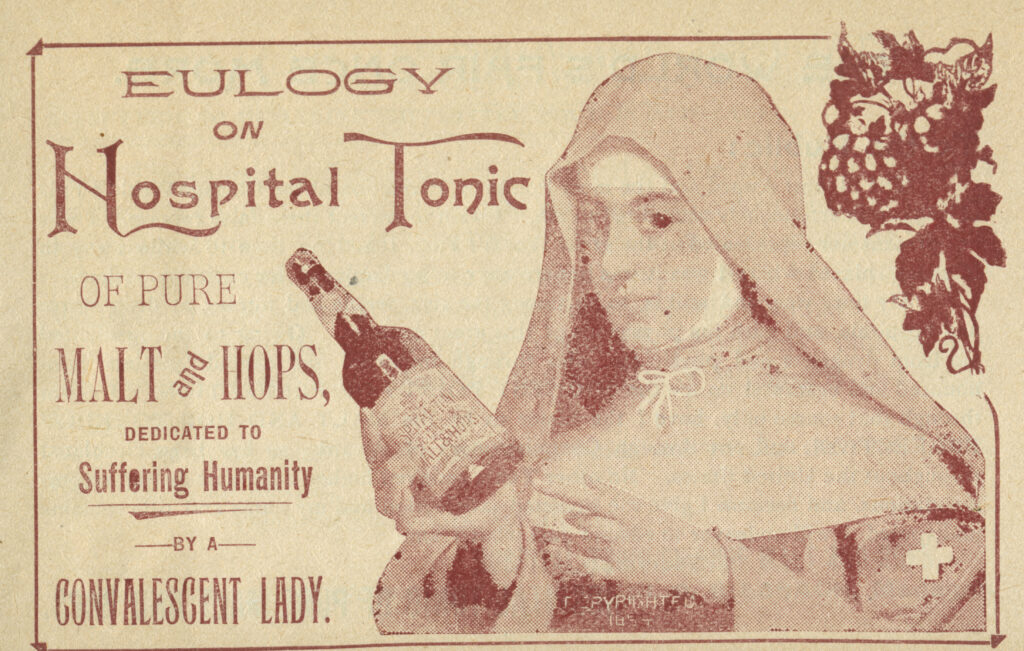
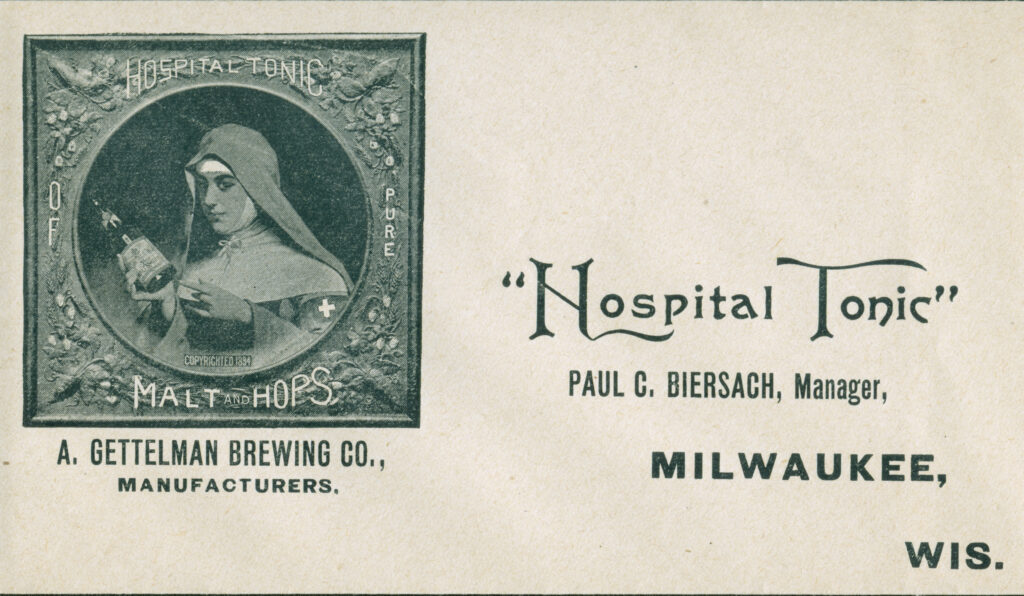
Booklet advertising Hospital Tonic of Pure Malt and Hops, manufactured by A. Gettelman Brewing Co., Milwaukee, Wisconsin. Cover illustrated with image of nun wearing first aid insignia on her arm and holding a bottle of Hospital Tonic, with an ornament of hops next to her. Inside front cover printed “The World’s Fair Once More” address “To the Public” by Hospital Tonic, in which the tonic denies having won top prizes at the Chicago World’s Fair despite “false reports.” Image from the Edward Kremers Reference Files Collection. Blank return envelope advertising Hospital Tonic of Pure Malt and Hops, manufactured by A. Gettelman Brewing Co., Milwaukee, Wisconsin. Envelope is addressed “‘Hospital Tonic’, Paul C. Biersach, Manager, Milwaukee, Wis.”. Envelope is illustrated with an image of a nun wearing nurse insignia on an armband and holding a bottle of Hospital Tonic. Image from the Edward Kremers Reference Files Collection.
Opinions of these Sisters varied depending on time and place. The anti-Catholic sentiment of Protestant America, the immigrant status of many Sisters, and the willingness to rub elbows with the lower-classes meant that the work these Sisters performed was not held in high esteem by groups such as the Protestant elite. Many firsthand accounts of Civil War veterans express admiration for the Sisters’ work ethic and discipline, and many are dismissive of their competence in comparison to men.
Despite the mixed and sometimes hostile perception of Catholic Sisters, they played a key role in growing the institution of the hospital in the United States. With minimal backing from the Catholic church, Sisters often took on the responsibility of fundraising to construct and maintain hospitals across the country. Oftentimes, Sisters managed and administered the hospitals they founded, a role which was uncommon for women to hold. These hospitals were known for their tendency to accept a wide variety of people, including non-Catholics. However, like most hospitals in the United States at this time the vast majority were still segregated by race, although there are some instances of Sisters admitting Black patients.
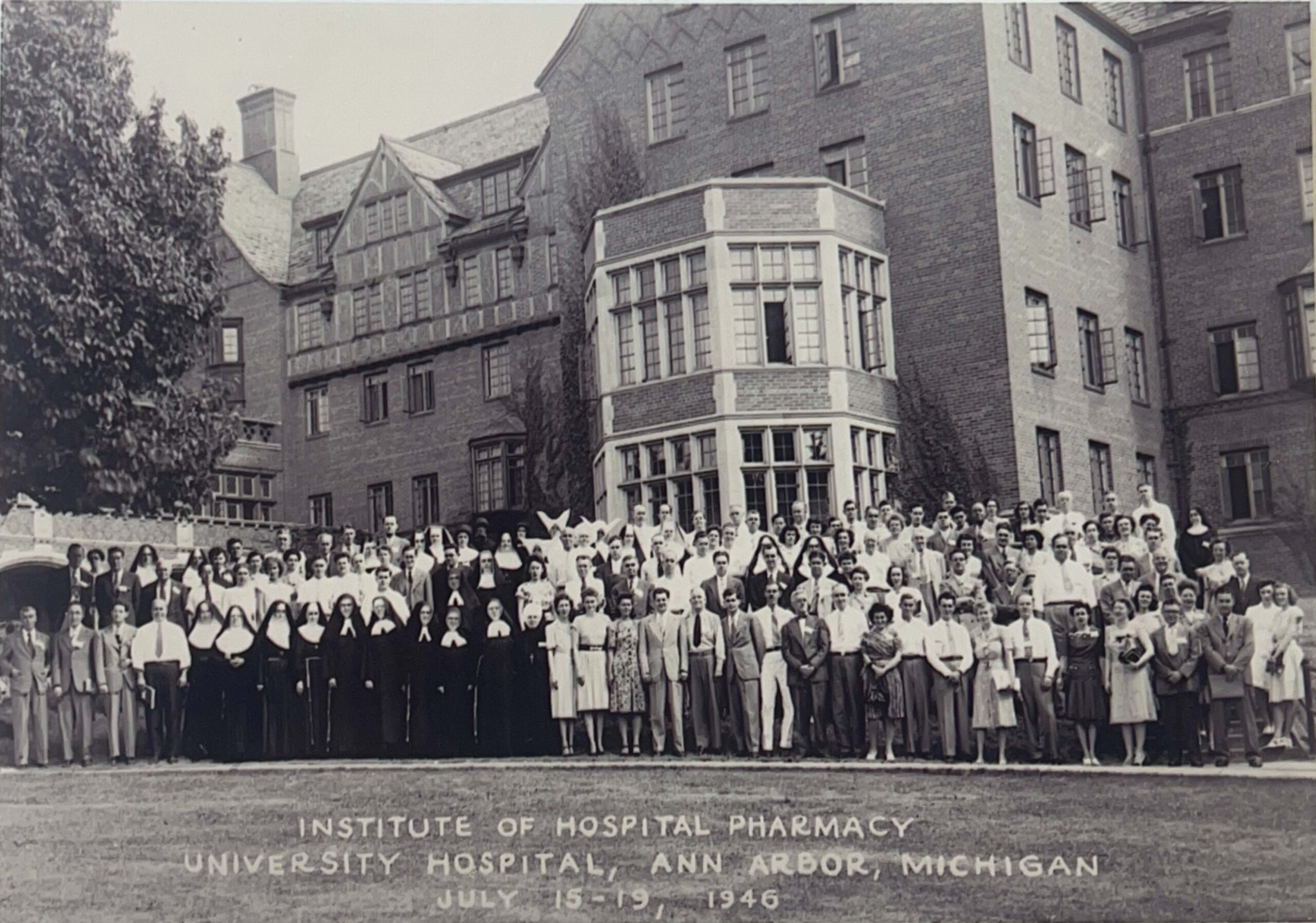
Image from the Metta Lou Henderson Collection in the Edward Kremers Reference Collection.Image of the St Francis Blue Island Pharmacy dated 1053 from the Metta Lou Henderson Collection in the Edward Kremers Reference Collection. Image of the Institute of Hospital Pharmacy University Hospital in Ann Arbor, Michigan, dated July 15-19, 1946 from the Edward Kremers Reference Collection.
In the late nineteenth century, the professionalization movement took off in the United States, which aimed to professionalize, standardize, and increase regulations on American medical institutions. Many Sisters expressed opposition to this since the increased regulations it brought meant that it would be harder for people without college degrees to work at hospitals. However, some Sisters would embrace the movement, and in many states the first women to obtain degrees in pharmacy were Sisters. Concurrently, women were obtaining increased access to medical fields, so Sister pharmacists would often work alongside non-Sister pharmacists. By the 1950s, several Sisters would become prominent contributors to pharmaceutical research, development, and education.
Although the groups discussed in this article share many religious and organizational principles, the groups themselves were incredibly diverse in terms of composition and ideology. Some groups allowed women from marginalized communities to strengthen their bonds with one another. On the other hand, some Sisters would play a significant role in the cultural assimilation of Native Americans at Catholic boarding schools. Sister nurses would allow many women of disadvantaged backgrounds to pursue labor that went beyond the domestic sphere, but they also reinforced patriarchal ideas of what roles women ought to play in their rhetoric. In sum, their legacy is complex. Their contributions to pharmaceutical practice, however, should not be forgotten.
This Dose of History was brought to you by AIHP Intern, Leo Ryan.
Bibliography:
Henderson, Metta Lou, and Sister Margaret Wright. “Sister Pharmacists and Pharmacy Practice from the 1700s to the 1970s.” Pharmacy in History 50, no. 2 (2008): 70–81. http://www.jstor.org/stable/41112389.
Henderson, Metta Lou, and Sister Margaret Wright. “Sister Pharmacists and Pharmacy Organizations, 1900 to 1980.” Pharmacy in History 50, no. 3 (2008): 87–96. http://www.jstor.org/stable/41112393.
Levin, Peter J. “Bold Vision: Catholic Sisters and the Creation of American Hospitals.” Journal of Community Health 36 (2011): 343-347. https://doi.org/10.1007/s10900-011-9401-7.
Warsh, Cheryl Krasnick. “Nursing: The Science of Womanly Arts.” In Prescribed Norms: Women and Health in Canada and the United States since 1800, 225–227. University of Toronto Press, 2010. http://www.jstor.org/stable/10.3138/j.ctvg5bs69.12.
Actively engaged in preserving the documents of pharmacy's past and developing materials for understanding the future.
January, 21, 2026, 11:00 am (Central):Pharmacy History Working Group: Spring Semester Welcome Back Event: A critical reading of Jacqueline Susann's Valley of the Dolls, hosted by Kelly O'Donnell, Towson Unviersity. February 18, 2026, 11:00 am (Central):Pharmacy History Working Group: Audrey Ke Zhao, UC Santa Cruz & CHSTM Research Fellow March 18, 2026, 11:00 am (Central): Pharmacy History Working Group: Ryan A. Kashanipour, University of Arizona
Upcoming events of interest to pharmacists and historians of pharmacy, pharmaceuticals, medicines, science, and related fields.
December 7-11, 2025: ASHP Midyear, Las Vegas, NV. January 14, 2026: JCPP January 2026, Alexandria, VA. March 27-30, 2026: APhA 2026, Los Angeles, CA. April 18-21, 2026: NACDS Annual Meeting, Palm Beach, FL. June 3-7, 2026: AAHM 2026, Buffalo, NY. June 13-17, 2026: ASHP Pharmacy Futures, Charlotte, NC. June 25, 2026: JCPP June 2026, Alexandria, VA. July 18-21, 2026:AACP Pharmacy Education, Grapevine, TX. September 17, 2026: JCPP September 2026, Alexandria, VA. October 3-6, 2026: 2026 NCPA Annual Convention, Kansas City.