
This issue of e-Scripts reports on Institute news and developments over the past few months. Please email us at aihp@aihp.org with your questions, feedback, and suggestions.
Greetings from Madison! I wanted to share a few items with you and send best wishes to all of our members.
Our Spring “Kreminar” was focused on the topic of community pharmacy (such an important topic that has been understudied, in my opinion). Thank you to all of our speakers and you can see the recordings of the talks on the AIHP YouTube channel. Please also note that the AIHP’s flagship journal History of Pharmacy and Pharmaceuticals has issued a call for papers on the topic of community pharmacy for an upcoming special issue.
I had a chance to visit the American Pharmacists Association headquarters with AIHP President John Grabenstein in June. We were given a very warm and gracious welcome by all of the staff at APhA and I’m looking forward to going back to visit again soon!
Here in Wisconsin, the topic of botanical medicine and especially medical cannabis have prompted major policy discussions. In my capacity as Urdang Chair and AIHP Executive Director, I have been asked to comment on multiple stories about the history, policy, and regulation of cannabis/hemp products. Here, I am keenly aware that history is repeating itself, considering past AIHP leaders like Edward Kremers and John Parascandola addressed such questions decades ago.
Also, be sure to come out and join us online. The AIHP is holding a special member-only meeting on October 21 at 11 am CST / 12 pm EST. The staff and board members will be there to provide updates about our vision and aspirations in the next few years. We will share newly developed member perks for you and, in particular, the staff and board want to give details about AIHP’s direction and the resources we need to get there! The link to attend is here.
It is such a unique moment in the history of the pharmacy profession and larger pharmacy and pharmaceutical landscape. AIHP has an important mission to chronicle and preserve that history. We value all of your ideas and support.
-Luc
AIHP is pleased to announce the US Public Health Service Chief Pharmacist Officer Oral-History Project is now available on the AIHP website.
This important project is the product of retired PHS Chief Pharmacist Officers (CPO) Richard M. Church and Richard Bertin, and William A. Zellmer, former AIHP Board President and a pharmacist with experience conducting oral-history interviews.

from left to right: William Zellmer, Richard Bertin (seated), and Richard M. Church
The project captures the lives and professional careers of all living retired PHS CPO whose careers span from 1967 to 2022, and whose service as CPO cover the period from 1987 to 2022. The interviews cover a wide-range of themes including pharmacy education as preparation for leadership in public health, federal health services as fertile ground for innovation in pharmacist roles, CPO’s outreach to the entire pharmacy profession, revitalization of the PHS Commissioned Corps under Surgeon General C. Everett Koop, and responses to national and global health emergencies.
AIHP wants to thank Church, Bertin, and Zellmer for their work completing this project and we are happy to host the transcripts on our website making them accessible to all.
To read the full story and access the transcripts, visit our website.
Call for Papers: “Within and Beyond the Pharmacy as Corner Store”
The History of Pharmacy and Pharmaceuticals (HoPP) is pleased to announce a call for papers for a special issue titled “Within and Beyond the Pharmacy as Corner Store.” This issue seeks to explore the multifaceted roles of community pharmacies both in the US and globally, focusing on their business, practice, marketing, advertising, retailing, and consumption.
Community pharmacies, essential healthcare providers, have faced significant challenges in recent years, from pharmacist mental health fatigue to opioid litigation. This special issue aims to foster discussions across disciplines and geographies, addressing these and other issues affecting community pharmacies.
The staff at AIHP and its flagship journal feel that understanding the history of community pharmacies is crucial for several reasons:
1. Public Health Access: Community pharmacies are often the most accessible healthcare providers, offering medications and advice without appointments. Studying their history highlights how these institutions have evolved in multiple ways to meet public health needs.
2. Economic Impact: The role of pharmacies in local economies and their transformation into chain stores can inform discussions on healthcare economics and business practices that have far-reaching implications.
3. Cultural Significance: Pharmacies are not just healthcare providers but also valuable social spaces. Their history reflects broader social changes, including shifts in gender roles, race relations, and class dynamics.
We invite scholars at all career stages to submit unpublished research based on primary sources. Topics of interest include, but are not limited to:
Submission Details:
For more information, visit HoPP Call for Papers on the UW Press website.
Contact: JamieBanksphd@gmail.com or AIHP@AIHP.org
“Community pharmacy,” sometimes called retail pharmacy, is arguably the most common type of pharmacy that offers the public access to medications and a knowledgeable healthcare provider. A community pharmacy, or drug store, also acts as a healthcare facility that is responsible for the provision of pharmaceutical services. Many, if not all, community pharmacies provide medicinal goods only available with a prescription and those with that can be purchased over-the-counter. Community pharmacists are considered to be the most accessible health professionals to the public, as they are available to provide personalized advice about health and medicine on a walk-in basis without the need for an appointment.
The 2024 Edward Kremers Seminar in the History of Pharmacy and Drugs focused on community pharmacy from a variety of perspectives and disciplines. In 2022-2023, the pharmacy space was forced to reckon with pharmacist mental health fatigue, strikes over pay and layoffs, pharmacy store closures, and ongoing opioid litigation related to pharmacy chains. To varying extents, all of these issues intersected with and impacted community pharmacy. The 2024 “Kreminar” aims to explore some of these topics from multiple angles and through a diverse group of speakers.
The Kremers Seminar in the History of Pharmacy & Drugs, sponsored by the University of Wisconsin–Madison School of Pharmacy and the American Institute of the History of Pharmacy, explores the history of pharmacy, pharmaceuticals, drugs, and medicines. The “Kreminar” features authors and scholars discussing their latest research and projects and aims to use history to inform contemporary understandings and debates about pharmacy, drugs, and medicines.
Featured Kreminars include distinguished speakers, Dr. Lucas Richert, AIHP Executive Director and University of Wisconsin-Madison Associate Professor and George Urdang Chair in the History of Pharmacy, Dr. Taylor Watterson, Assistant Professor at the University of Illinois Chicago College of Pharmacy, Dr. Liz Chiarello, Associate Professor of Sociology at Saint Louis University, and Hannah Rose Swan, archivist at the University of Wisconsin-Madison School of Pharmacy Edward Kremers Research Library and Archive.
Visit the website for more information and to watch the recordings of the presentations.
Don’t miss out on future programming. Renew now to secure your invitation to the next Kreminar and more! The AIHP has always had a dedicated and energetic base of of members and we continue to need your support. Please renew your membership and encourage others to renew, or even join the organization!
If you want to stay a member in 2024 and beyond, be sure to visit the AIHP website!
The R. Ken Coit College of Pharmacy and the University of Arizona are advertising an exciting pharmacy history role. The Coit Musuem is looking for a Director to help connect people to pharmacy and the health sciences. Founded in 1966, the Museum collection has grown to an estimated 15,000 objects, mostly from the 19th and 20th centuries. The collection includes drug products, apothecary jars and glass bottles, mortars and pestles, show globes, beauty products, oils, microscopes, medical equipment, drug store ephemera, photographs, books, and archival records. To learn more, visit the job advertisement. Thank you to long-time AIHP member Metta Lou Henderson for sharing this with AIHP staff.
The American Institute of the History of Pharmacy is thrilled to announce that the latest batch of trade catalogs, digitized in collaboration with the University of Wisconsin Digital Collections Center (UWDCC), is now live!
The AIHP jointly holds one of the top pharmaceutical trade catalog collections in the world and has been working with UWDCC since 2021 to make them available on the Digital Collections website. The AIHP and UWDCC have digitized 38 catalogs to date, totaling 14,413 pages. Additionally, the AIHP and UWDCC have collaborated to digitize 840 photos from the Drug Topics Photo Collection.
The trade catalogs in the collection date from 1829 to 2000 and highlight medicines, chemicals, products, and equipment used and sold by pharmacies. They can help historians track wholesale pricing over time, learn what medicines and products were available when, and provide a visual record of packaging design. They’re also full of incredible illustrations and typography that can be used as a reference for contemporary artists and graphic designers.
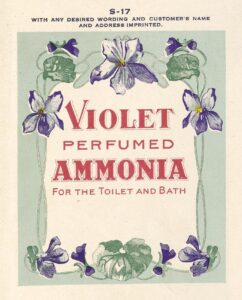
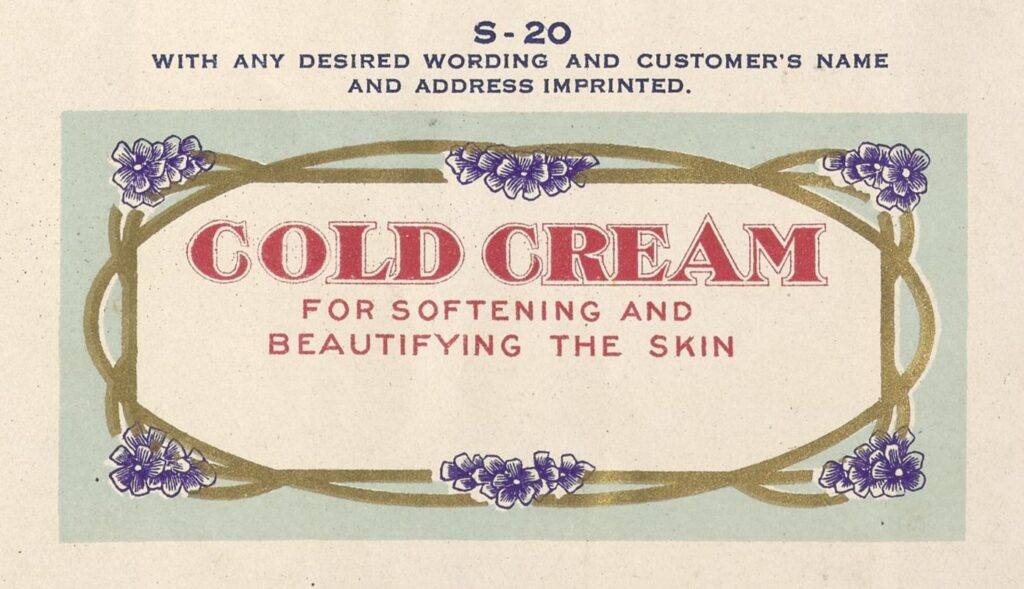
For example, the latest set of trade catalogs digitized includes a number of catalogs for druggists’ labels. These refer to printed or handwritten labels that pharmacists would use when dispensing medications or giving information about in-house products sold at their pharmacies. Labels were a way of distinguishing the pharmacist from his or her competitors. In 1911, an article in The Chemist and Druggist advised that “every label is an advertisement, and care should be taken to make it an effective one.” In short, labels in the recently digitized trade catalogs provide valuable information to historians about medicines, compounding, and pharmacy locations; however, they also serve as a record of developments in commercial design and printing, as well as marketing and advertising.
In 2023, UW-Madison School of Pharmacy archivist Hannah Swan presented a short video at the Society for Textual Scholarship’s annual conference on the interconnected history of pharmacy labels and printing histories. To watch the video and many other engaging videos on the history of pharmacy, visit the AIHP YouTube channel!
Join Melissa Murer Corrigan, former AIHP Board of Trustees member and host of the MelisRxScripts podcast, in her 58th episode, “Learn, Grow, and Move Forward: Leading Change,” featuring Dr. Jenny Bingham, Senior Research Associate at Pharmacy Quality Alliance.

Melissa Murer Corrigan, host of MelisRxScripts
The discussion includes Dr. Bingham’s research with AIHP Board of Trustees President John Grabenstein on the history of American pharmacy, and insights on innovation, research, and resilience.

Dr. Jenny Bingham
MeslisRxScripts is a podcast that features lively conversations with friends, colleagues, and various leaders in health care, pharmacy, and beyond, and a place to find prescriptions for life that you can apply each day.
Listen to the full podcast here.
The French Society of the History of Pharmacy has announced the publication of a special issue of their esteemed journal, the Revue, which explores artistic earthenware drug containers. In both French and English, this issue of 488 pages includes 184 pots reproduced in color and described in detail. The author is Olivier Lafont, well-known historian of pharmacy and recipient of AIHP’s George Urdang Medal. The special issue is available for 35 Euros plus 10 Euros shipping. The form for ordering is linked here.
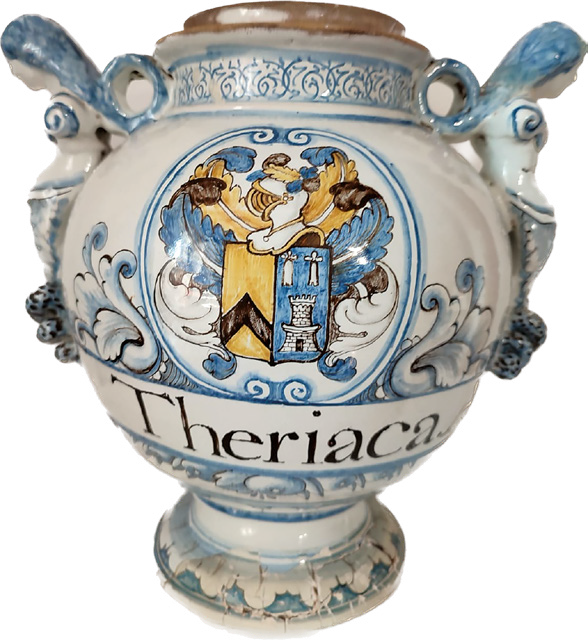
Here is an example from the book. It is a large show pot, equipped with handles in the shape of sirens, from Montpellier, ca 1665/1668, h = 32 cm, with the arms of alliance of the families AZEGAT and MONTFORT. Above the coat of arms are a helmet and stylized acanthus leaves. A band contains the inscription: “Theriaca.” At the neck runs a frieze of scrolls. This pot comes from a convent in Arles. Theriac was the most famed medicament of Renaissance Europe, made commonly from recipes with scores of ingredients, usually including the flesh of poisonous vipers as well as opium. It was renowned as a universal antidote to poisons.